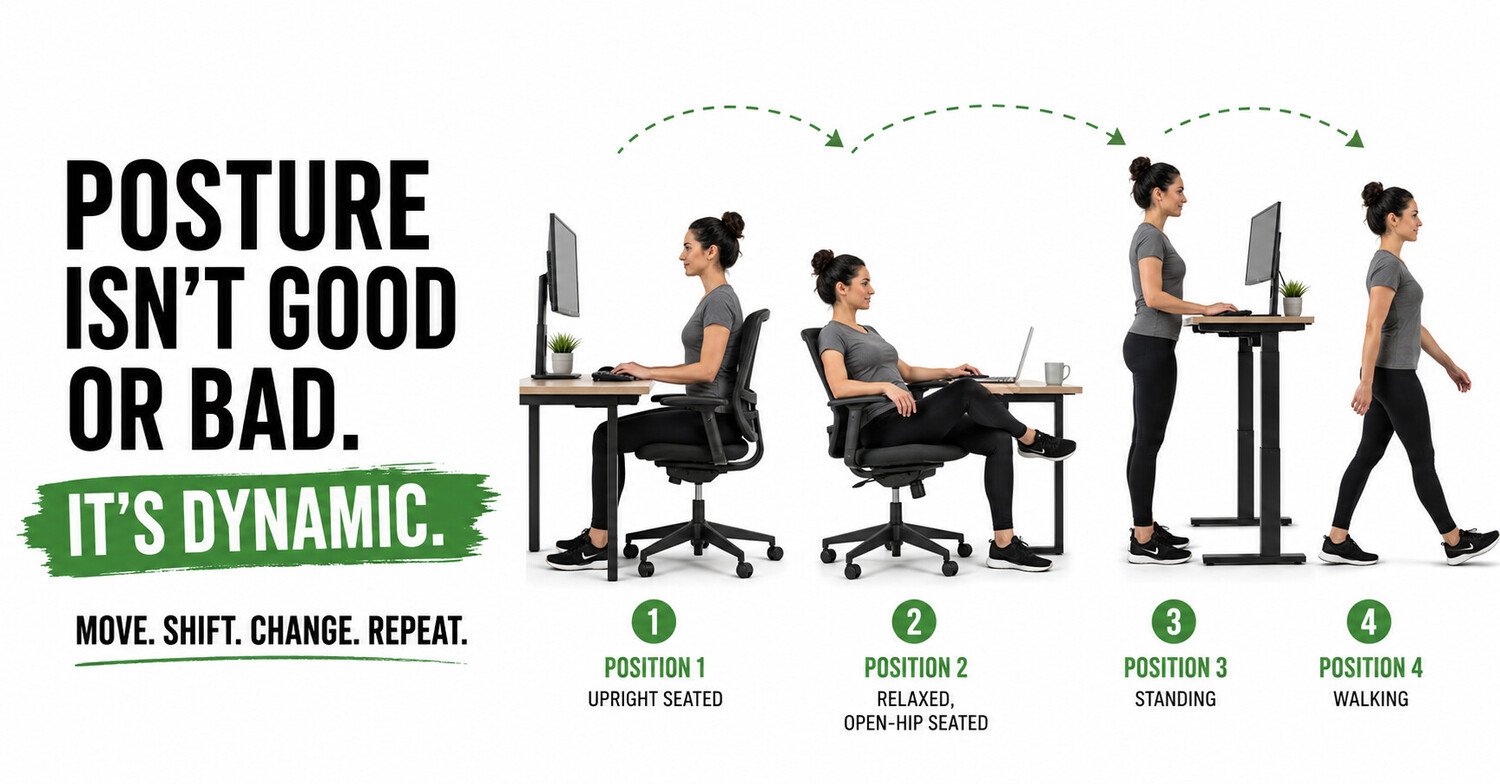
We’ve all been told some version of the same story.
Sit up straight. Shoulders back. Head up. Don’t slouch.
And somewhere along the way, that turned into the idea that there is one “perfect” posture we should all be trying to find.
There isn’t.
Your body is designed to use lots of different positions.
Sitting upright isn’t automatically good. Slouching isn’t automatically bad.
Leaning back, crossing your legs, shifting to one side, standing, moving around… all of those are positions your body should be able to tolerate.
But the only bad posture is the one you’re in too long.
Because even a “good” posture becomes less good when you ask your body to stay there for hours.
Good posture held too long eventually becomes bad posture.
So instead of constantly asking yourself whether you’re sitting properly, a better question might be:
How long have I been sitting like this?
Shift your position.
Lean back.
Cross the other leg.
Stand up.
Walk around.
Then sit down again.
Your next posture is your best posture.
Which sometimes creates another question: If posture isn’t simply good or bad, why would we measure it so specifically in the office? Because it gives us a baseline.
When we assess your posture, we ask you to stand there, look straight ahead and not think about it.
It gives us a snapshot of your body’s natural set point.
Your posture on its own doesn’t necessarily tell us what symptoms it may be contributing to.
It gives us clues.
Those clues become one piece of the bigger picture alongside how you move, how your spine moves and functions, what symptoms you’re experiencing and everything else we assess.
The goal isn’t to spend your entire day thinking:
Shoulders back.
Chin tucked.
Core tight.
That sounds exhausting.
The goal isn’t perfect posture.
The goal is adaptability.
You want a body that can sit, stand, move, shift and comfortably tolerate lots of different positions. And if you spend a lot of your day looking forward or down at a screen, one of my favourite movements for almost everybody is a chin tuck.
[Watch: How to Do a Chin Tuck]
If you’d like something a little more structured, let us know and we’ll send you along our in-depth posture program.
#BeAwesome
Dr. Chris

Christopher Small
Contact Me